
It is the first real question almost every seller asks us, and it usually arrives in the same shape.
The kitchen is original. The bathrooms are original. There is carpet in the bedrooms and popcorn on the ceilings. Do we fix it, or do we just sell it the way it is?
There is no honest way to answer that in the abstract. So instead of theorizing, here is a sale we just finished where we made the call, spent the money, and watched what happened.
We filmed the whole thing. Watch it below, then read on for the numbers and for what this means if your home is inside the gates.
The Situation That Started It
The home was 838 Sandberg Lane in Ventura — a two bedroom, two bath single story in the La Ventana community. Not Leisure Village, but a home with the same essential problem: well cared for, original owner, and untouched for a long time.
The family circumstances will be familiar to a lot of people reading this. Mom had passed away. Dad was moving into assisted living. Their son lived out of state and was serving as trustee, which meant he was making decisions about a house he could not walk through on a Saturday afternoon.
He wanted it handled. That is a very different assignment than "get me the highest possible number," and it changes what good advice looks like.
Sell As-Is, or Fix It First
Selling as-is was a legitimate option and we said so. It is fast, it is simple, and for a trustee three states away there is real value in simple.
But we ran the other number too — what the home would appraise and sell for updated — and the gap between as-is value and market value was large enough that leaving it alone would have cost the family more than the work would.
That is the entire test. Not "would this look nicer." Not "does it need it." Just: is the spread between as-is and updated bigger than the cost and the time?
Here, it was. So we made a plan.
What We Actually Did
About $30,000 to $35,000 in targeted improvements, done over roughly one month:
Scraped the popcorn ceilings. The single most dating feature in a home of this era, and the one buyers read as "this house has not been touched."
Vinyl plank flooring throughout, with new baseboards. Replacing carpet is not optional at this level of the market. Continuous flooring also makes a small home read larger, which matters at 1,081 square feet.
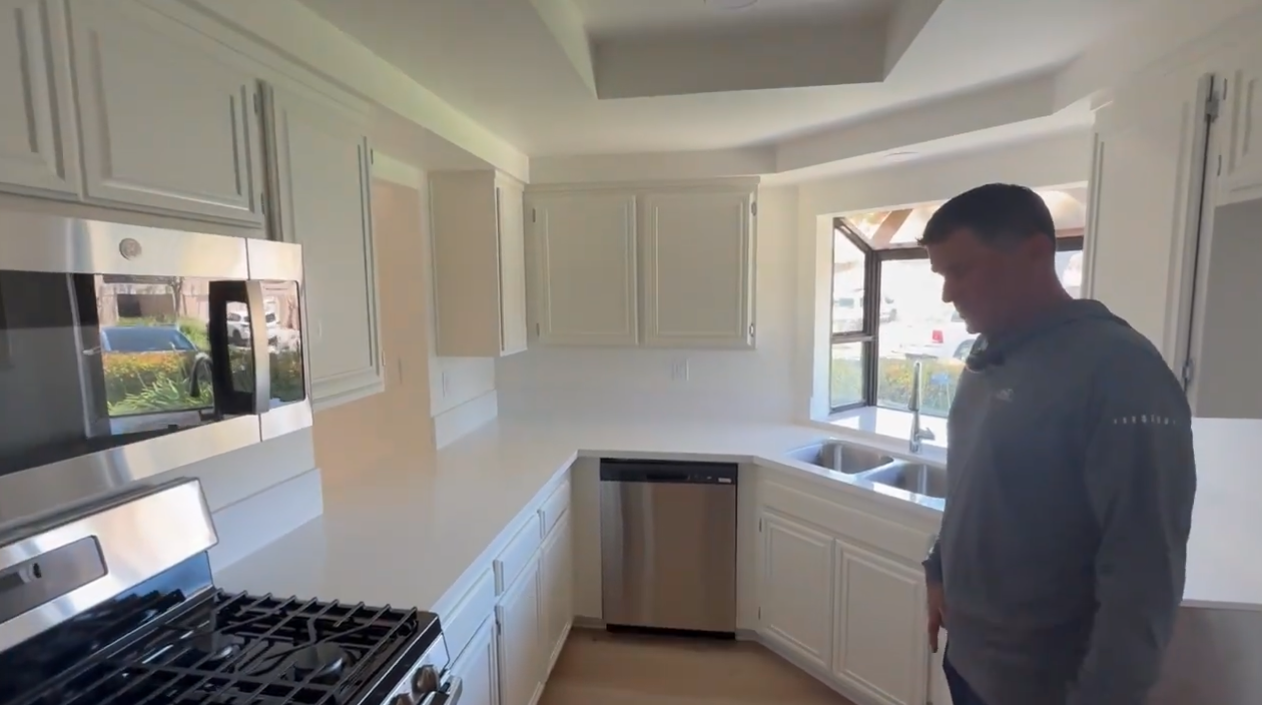
Painted the kitchen cabinets, new countertops, new appliances. Note what we did not do — we did not rip out the cabinets. Painting boxes that are structurally fine and putting the money into surfaces and appliances is most of the visual result for a fraction of a full remodel.
Fresh paint throughout. Neutral, everywhere.
Epoxy refinish on the tub, refinished the bathroom countertop. Refinishing rather than replacing. Same logic as the cabinets.
New lighting throughout. The cheapest line item on the list and one of the most effective.
Read that list again and notice what is on it. Every item is cosmetic and every item is visible. Nothing structural. Nothing behind a wall. No permits, no engineers, no surprises.
The Cost, and the Result
Roughly $35,000 in, about a month of work.
The home listed at market price and sold for full list price — $665,000, per the listing record. It closed with a buyer represented by an outside brokerage, which is worth mentioning only because it means the price was tested by the open market rather than negotiated in a corner.
The sign came down. The trustee got a clean close from out of state.
Why This Matters More in Leisure Village Than Almost Anywhere
Here is the part that should get your attention.
Every home in Leisure Village was built in the same era, off the same set of original floor plans, with the same bones. Roughly 2,100 homes across 35 villages, most of them 1978 construction. Which means the housing stock has a shared starting condition — popcorn ceilings, original kitchens, original baths, carpet — and a shared set of fixes.
That has two consequences.
First, buyers here have a very direct comparison. A buyer shopping Leisure Village is looking at multiple homes in the same model, sometimes the same week. When one El Dorado has been updated and another has not, the difference is not abstract to them. It is Tuesday afternoon, and they walked through both.
Second, the work is unusually predictable. Contractors who work inside the gates have done these exact ceilings, these exact kitchens, these exact bathrooms, hundreds of times. There is less discovery risk in a Leisure Village renovation than in almost any other housing stock in Ventura County, because there is very little left to discover.
There is a third thing, and it is specific to how this community is built. Your HOA already handles the exterior — grounds, paint, roof, the landscaping out front. In a normal single family sale, curb appeal is a variable you have to spend money on. Here it is largely handled for you.
Which means the interior is essentially the whole decision. That narrows the question considerably, and it is why the Sandberg list translates so cleanly: ceilings, floors, kitchen surfaces, paint, bath refinishing, lighting. That is a Leisure Village punch list almost word for word.
What We Would Look At First
If you are thinking about this for your own home, the order we would generally work in:
- Ceilings. Popcorn removal changes how a whole home reads, and it is disruptive enough that buyers heavily discount having to do it themselves.
- Flooring. Carpet out, continuous hard surface in.
- Paint. Neutral, throughout, no exceptions.
- Kitchen surfaces and appliances. Counters, hardware, appliances, cabinet paint — before you consider new boxes.
- Bathroom refinishing. Epoxy and refinishing before replacement, most of the time.
- Lighting. Last on the list, first in cost-effectiveness.
We are not going to publish a dollar figure for a Leisure Village home, because it depends on your model, your square footage, and what has already been done. The Sandberg number is a real number for a real project of a specific size — treat it as a reference point, not a quote.
When As-Is Is Genuinely the Right Call
We would be doing you no favors if we only made the case for spending money. As-is is the better answer when:
- The estate needs to close quickly and certainty is worth more than the spread
- No one is available to manage a month of contractors, and there is no local family to lean on
- The home has real deferred maintenance rather than dated finishes — those are different problems, and cosmetic work does not solve the first one
- The spread between as-is and updated in the current market simply is not wide enough to justify the outlay
The point is not that everyone should renovate. The point is that the choice should be made with both numbers in front of you.
The Part That Is Not About Money
The Sandberg sale involved a trust, a parent's move to assisted living, and a family managing it from a distance. That is not an unusual set of circumstances in a 55+ community. It is the ordinary one.
If that is where you are — sorting out a parent's home, serving as trustee, trying to decide from out of town whether to spend money on a house you are about to sell — the renovation question is genuinely the smaller half of it. The larger half is having someone local who will tell you the truth about whether the work is worth doing, and then handle it if it is.
That is the job. Not putting a sign in the yard.
Talk It Through Before You Spend Anything
If you are within a year or two of selling a home in Leisure Village, the useful conversation happens before you write a check to anyone. We will walk your home, tell you what we think it sells for as-is, tell you what we think it sells for updated, and be straight with you if the answer is that the work is not worth it.
No cost, no pressure, and we are happy to have the conversation for a move that is still well out.
McKay Barlow, The Barlow Group — 805-977-6716
Serving Leisure Village, Camarillo, Ventura, Oxnard, and surrounding Ventura County communities.
Curious what the different Leisure Village models sell for? Click Here to request access to our full floor plan library.
Check out this article next