
Here is a sentence we hear several times a month from people buying in Leisure Village Camarillo, and it almost always arrives in the same shape.
"We love it here. We are just going to wait until rates come down."
It is a reasonable instinct. Nobody wants to lock in a payment they suspect will look expensive in eighteen months. And we are not going to stand here and tell you that rates will not come down, because we do not know that, and neither does anyone else who is willing to say it out loud.
But there is a second half to that sentence that almost nobody says, and it is the half that costs money.
You Are Not the Only One Waiting
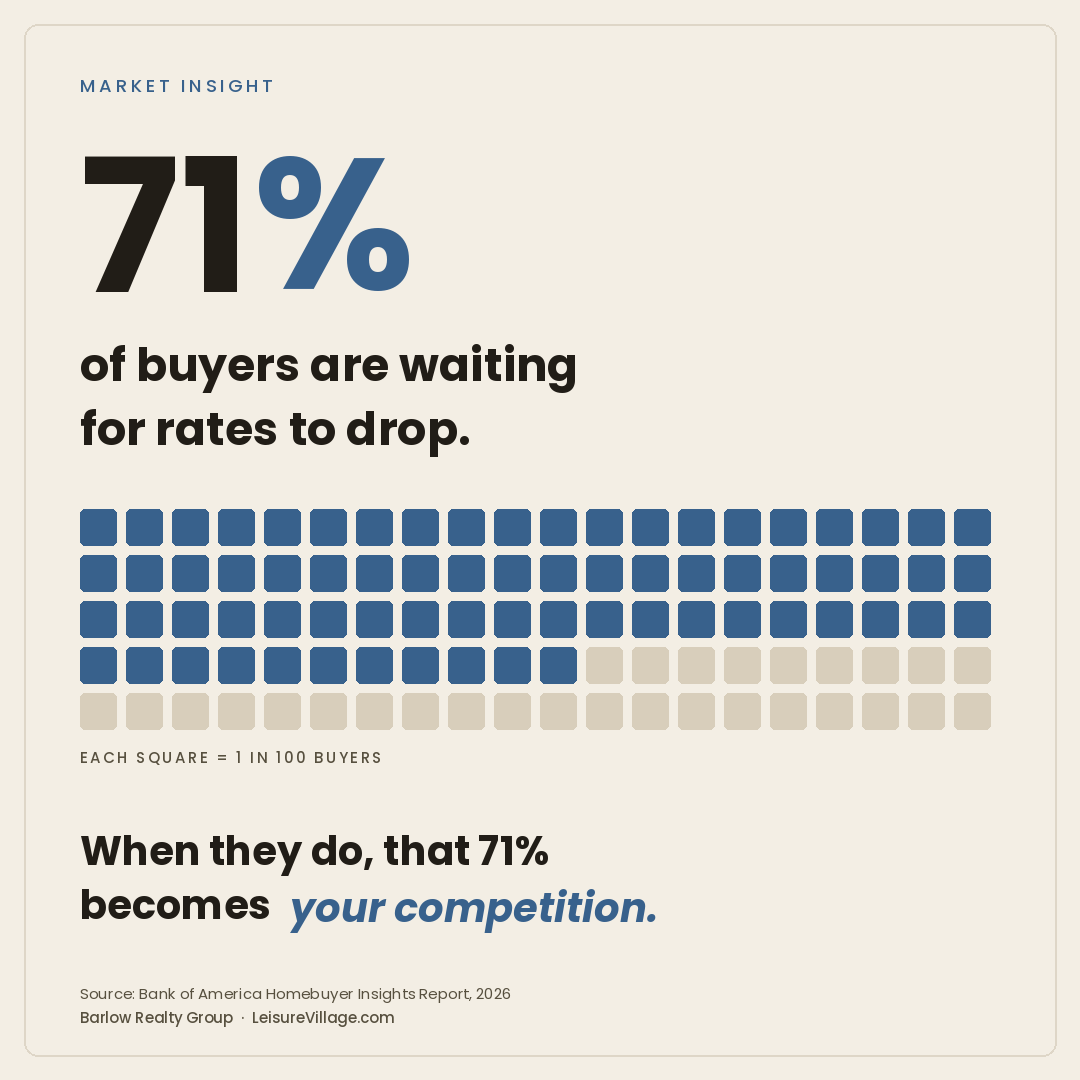
Per the Bank of America Homebuyer Insights Report, 2026, 71% of buyers say they are waiting for rates to drop.
Sit with that number for a second. Seventy-one out of every hundred people who want a home are standing in the same hallway you are, watching the same headline, waiting for the same signal. Not a handful of cautious buyers. The overwhelming majority of the market.
Which means the thing you are waiting for is also the starting gun for everyone else.
When rates fall, that 71% does not politely file in behind you. They become your competition — on the same listing, on the same weekend, with better financing than they had last month and the same idea you had. Lower rates do not just improve your payment. They improve everyone's buying power at once, and buying power that arrives all at the same time has a name. It is called a bidding war.
That is the part of "we will wait" that does not show up in the calculation.
What Two Years Actually Costs
We ran this at $650,000, because that is closer to the middle of what trades inside these gates than the numbers you see in national charts. Two-year window. Average appreciation, which works out to roughly 3.5% a year — not a bold forecast, a boring one.
Buy today: $650,000.
Buy the same home in two years: $696,296.
The difference is $46,296, and it buys you nothing. Not a better model. Not a bigger garage. Not a renovated kitchen. The identical home, two years later, for forty-six thousand dollars more.
That is the number we would put in front of you first, because it is the one that does not depend on how you pay. Cash buyer, twenty percent down, anything in between — you write the bigger check either way. It is the cost of the calendar, not the cost of the loan.
What It Does to the Financing, If You Are Financing
At 20% down and a 30-year fixed at 6.75%, the rest of it stacks up like this.
Your down payment grows by $9,259. Twenty percent of $650,000 is $130,000. Twenty percent of $696,296 is $139,259. Same house, larger check at the closing table.
Your loan is $37,037 bigger, which at the same rate is about $240 more per month — roughly $3,373 in principal and interest today versus $3,613 in two years. That is before taxes, insurance, and dues, which are on top in both columns.
And you forgo $11,470 of principal paydown. Twenty-four payments into a thirty-year loan is not glamorous work. It is unglamorous, automatic, and entirely yours. Waiting does not defer it. It deletes it.
Put the whole thing on a balance sheet and you are $48,507 behind on equity by 2028 — $187,766 if you buy now, $139,259 if you wait.
One honest note about that last figure. The equity gap shrinks as your down payment grows, and at all cash it collapses to zero. That is not because waiting became free. It is because the equity metric quietly credits you for writing a larger check. The $46,296 is the real number. The equity gap is the accounting.
The California Wrinkle Nobody Mentions
There is one more consequence of buying at the higher price, and it does not go away.
Your property tax basis is set at what you pay. Buying at $696,296 instead of $650,000 means an assessed value that is $46,296 higher — permanently, adjusted upward each year within the statutory cap. At Ventura County rates that is somewhere in the neighborhood of $500 a year, every year, for as long as you own the home. Over a decade it runs past $5,000.
If you are 55 or older and selling a California home to move here, you may be able to transfer your existing basis under Proposition 19, which changes this math meaningfully. It does not erase it — the difference in price still gets added on — but it is worth a conversation with your tax professional before you assume either version applies to you. We are real estate brokers, not tax advisors, and this is a question where the difference between the two matters.
The Number That Is Missing From Every Chart
None of the payment figures above include HOA dues, and in Leisure Village that is not a rounding error.
Per the 2026-27 dues schedule, monthly dues here run from $671 on the Avalon up to $1,014 on the La Jolla. They are assigned by model — not by village, and not by what you paid. Two owners of the same model pay the same amount no matter where in the community they sit.
That is real money and we are not going to hide it inside a payment estimate. But look at what it replaces before you file it under expense: a 24-hour guarded gate and patrolling security, medical first response, water, sewer and trash, exterior paint, lifetime roof protection, flood and earthquake insurance, Spectrum internet and HDTV with DVR and HBO, an 18-hole golf course, an Olympic heated pool, hot tub, fitness center, pickleball, tennis, bocce, shuffleboard, a woodshop, ceramics, sewing and lapidary rooms, and RV parking.
Add up what you currently pay for the insurance, the internet, the water bill, the gym, and the roof fund you may or may not be keeping. Then decide what the dues actually cost you. Most people find the honest number is a good deal lower than the sticker.
Why This Lands Differently in a 55+ Community
Here is where the general-market version of this argument stops being quite right for our buyers.
A significant share of the people buying here are not financing the way that chart assumes. They have sold a larger home somewhere else, and they are paying cash or putting down far more than twenty percent. If that is you, the rate conversation is close to irrelevant. You are not waiting on a mortgage rate. You are waiting on a feeling.
But notice what does not change. The $46,296 has nothing to do with financing. A cash buyer waiting two years pays it in full, in cash, and never sees a rate sheet. The rate was never the part of the equation that was costing you money — the price was. Waiting for rates to fix a problem that rates did not cause is the most expensive version of this mistake, and it is the one we see most often in a 55+ community.
There is also a timeline nobody puts on a spreadsheet. If you are 68 and you wait two years for a better rate on a house you were going to buy anyway, you did not save money. You spent two years.
Where These Numbers Do Not Apply
We are going to be direct about this, because the alternative is letting a chart do your thinking for you.
The $650,000 is a reference point, not a quote. There are twenty-five model variants here and the spread between them is real. What you pay depends on the model, on what has already been done to the home, and on where it sits. Do not take a number off this page and apply it to a home you have looked at.
The 3.5% appreciation is an assumption. A reasonable one, drawn from long-run averages. Not a promise. If prices go flat for two years, most of the $46,296 goes with them. We are not going to tell you which way this market moves, because we do not know, and neither does the person telling you they do.
The payment figures are principal and interest only. Taxes, insurance, and dues are extra, and they are not small. Confirm your own numbers with your lender before you commit to anything.
And "buy now, refinance later" is a strategy, not a guarantee. It requires rates to actually come down, and it requires you to still qualify when they do. The test is not whether you can carry this payment until you refinance. The test is whether you can carry it if you never refinance. If the answer is yes, a refinance is upside. If the answer is no, no equity projection makes the purchase right, and you should not let a chart talk you into it.
When Waiting Is Genuinely the Right Call
We would be doing you no favors if we only made the case for buying now.
If you have not sold your current home yet, and the purchase depends on those proceeds, wait. Sequencing matters more than timing, and we would rather help you plan the order than watch you carry two properties.
If the payment only works on the optimistic version, wait. See above.
If your circumstances are genuinely unsettled — a health question, a spouse who is not ready, an adult child in the middle of something, a job that has not finished being a job — wait. That is not an unusual set of circumstances in a 55+ community. It is the ordinary one, and moving into a home while the rest of your life is still moving is how people end up selling in eighteen months.
If you have not spent real time in the community, wait long enough to spend it. Come through, walk it, sit by the pool on a Tuesday. Forty-six thousand dollars is a lot of money. It is not enough to justify buying into a place you have not actually decided you want to live.
We have talked people out of buying here. We have also talked sellers out of listing — sometimes into waiting, sometimes into renting the home out instead. That does happen, and if renting is the better path for your situation, we handle property management too.
The Part That Is Not About Money
Every number above is real and every one of them matters less than the reason you were looking in the first place.
People do not move to Leisure Village for the appreciation. They move because the yard maintenance stopped being fun, because the stairs became a factor, because the house they raised a family in has four bedrooms and two occupants, and because there is something to be said for a place where the gate is staffed and somebody notices when you have not been at the pool.
Two years is a meaningful fraction of the good years. That is the cost that does not appear on the spreadsheet, and in our experience it is the one people regret.
Run Your Own Numbers Before You Decide
If you are weighing this, we would rather you make the decision with your actual figures than with a general-market illustration.
What that conversation includes: the realistic price range for the models you are considering · the dues for those specific models, from the current schedule · what your down payment does to the math · an honest read on whether waiting is the better call for your situation
To talk it through, or to see what is currently available inside the gates, reach out anytime. Happy to answer questions for a move that is still a year or two out — no pressure either way.
McKay Barlow, Barlow Realty Group — 805-977-6716
Serving Leisure Village, Camarillo, Ventura, Oxnard, and surrounding Ventura County communities.
Not sure which variant you are looking at, or what it pays in dues? The full model and dues schedule is here, along with every floor plan in the community.
Check out this article next